From the latest edition of each brief.
Pan-RAS drugs report pancreatic cancer responses, and Actinogen’s Alzheimer’s trial misses.
01
Must read
What happened
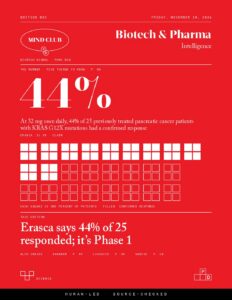
Erasca reported updated Phase 1 data from AURORAS-1 on 11.20 for ERAS-0015, an oral drug it calls a pan-RAS molecular glue that also hits normal, unmutated RAS. At 32 mg once daily, 44% of 25 previously treated pancreatic cancer patients with KRAS G12X mutations had a confirmed response (95% CI about 24 to 65%, our calculation). In the 13 with G12D or G12V, it was 69% (about 39 to 91%). In lung cancer after immunotherapy and platinum it was 60% (n=5), and in biliary tract cancer 75% (n=4). Across 122 patients on 16 to 32 mg, there were no dose-limiting toxicities. At 32 mg, 13.0% had doses interrupted, 16.7% had doses reduced and none stopped. A grade 5 pneumonitis was first disclosed in April 2026. Erasca plans a first-line pancreatic Phase 3 to start in the first half of 2027. Claim
Why it matters
These are small, single-arm groups with no control, so they cannot show the drug beats other treatment, and a response rate is not survival. They add a second pan-RAS drug to a field where daraxonrasib is already approved. Analysis
What we’re watching
Durability of the responses, a full grade 3 or higher adverse event count, and the Phase 3 designs.
CLAIM CHECK
Partial NCT06983743 registers dose-limiting toxicities, maximum tolerated dose, recommended dose, adverse events and pharmacokinetics as primaries; response rate, the headline, is a secondary.
Erasca (11.20) (opens another website in a new tab) Co; NCT06983743 (opens another website in a new tab) Reg
02
Must read
What happened
In a late-breaker at ENA 2026, Revolution Medicines reported updated Phase 1/2 data for Rasonque (daraxonrasib), 200 mg, with gemcitabine and nab-paclitaxel as first-line treatment for metastatic pancreatic cancer. In 61 patients followed for a median of 18.3 months, 60.7% had a confirmed response (95% CI 47.3 to 72.9). Complete responses were 8.2%. Median progression-free survival was 12.8 months and the 12-month overall survival rate 76.6%. The company called the safety consistent with the known profiles and gave no grade 3 or higher rates in its release. The randomized Phase 3 RASolute 303 is ongoing. Claim
Why it matters
FDA approved daraxonrasib on 08.26.2026 for metastatic pancreatic cancer after prior systemic therapy, or when multiagent therapy is not an option. These first-line numbers come from one arm with no comparator, so they cannot be set against chemotherapy alone. Analysis
What we’re watching
RASolute 303’s readout and the grade 3 or higher toxicity of the combination.
CLAIM CHECK
Partial The release gives no registry number. The matching study we found, NCT06445062, a platform trial, registers adverse events and dose-limiting toxicities as primaries for this combination; response and survival are secondaries.
Revolution Medicines release on GlobeNewswire, read through Investing News (11.19) (opens another website in a new tab) Co; NCT06445062 (opens another website in a new tab) Reg
03
Must read
What happened
Actinogen said on 11.19 that XanaMIA, a randomized, double-blind, placebo-controlled Phase 2b/3 trial of Xanamem (emestedastat), an oral 11β-HSD1 inhibitor, in 247 people with mild to moderate Alzheimer’s disease and raised pTau181, missed its primary endpoint. The mean benefit on CDR-SB at week 36 was 0.10 points versus placebo (p = 0.65), which the company calls “numerically, but not statistically superior.” In a prespecified subgroup above the median age of 75, 40% versus 22% showed no progression on CDR-SB (p = 0.02), while the mean slowing of 0.39 points was not significant (p = 0.22). The company reports no drug-related serious adverse events and plans talks with FDA and partners on a path in older patients. Claim
Why it matters
A subgroup result after a missed primary can point to the next trial but cannot carry this one. Analysis
What we’re watching
What FDA says about the older-patient path, and the open-label extension results the company plans to present at a future scientific meeting.
CLAIM CHECK
Match NCT06125951 registers CDR-SB change at 36 weeks as its efficacy primary, with adverse events as a second primary, and 247 enrolled; the release reports that measure. The age subgroup is not a registered primary.
Actinogen, via BioSpace (11.19) (opens another website in a new tab) Co; Biotech Dispatch (11.19) (opens another website in a new tab) Press; NCT06125951 (opens another website in a new tab) Reg
04
Know it
What happened
Alnylam said on 11.19 that FDA approved Livsayis (cemdisiran), from its collaborator Regeneron, for adults with generalized myasthenia gravis who test positive for antibodies to the acetylcholine receptor. It silences C5, a complement protein, and is given under the skin four times a year. Alnylam calls it the first RNAi therapy for the disease and the seventh approved drug discovered by Alnylam, and it receives a $25M milestone and royalties of up to 15%. FDA’s novel approvals list dates the approval itself to 11.18. Claim
C5 blockade is already used in this disease; dosing four times a year is the difference the companies stress. We did not read the label. Analysis
Alnylam release on Business Wire, read through Yahoo Finance (11.19) (opens another website in a new tab) Co; PharmExec (opens another website in a new tab) Press
05
Know it
What happened
AbbVie and DISCO Pharmaceuticals agreed on 11.19 to a research collaboration with an option to license AND-gated bispecific antibodies for solid tumors, which aim to act only on cells carrying two antigens. DISCO gets $40M upfront and is eligible for up to $2.5B in option, development and other milestones, plus royalties; targets were not disclosed. AbbVie Ventures is an existing investor in DISCO, a company in Cologne, Germany, which closed a €36M seed round in December 2025. Separately, Bloomberg reported, citing unnamed people, that Sanofi is weighing a takeover bid for Insmed. No price was reported, Insmed declined to comment, and no deal has been announced. Claim
The DISCO upfront is small next to its milestones, so most of the headline value depends on future options. A reported interest in a deal is not a deal. Analysis
BioSpace (11.19) (opens another website in a new tab); Bloomberg report as relayed by Pharmaceutical Technology (11.20) (opens another website in a new tab) Press; Sofinnova Partners (12.11.2025) (opens another website in a new tab) Co
BRIGHT SPOTIn NEJM, the PARADIGM4TB platform trial tested new four-drug, 16-week tuberculosis regimens in 401 people. A regimen built on the DprE1 inhibitor BTZ-043 cleared culture faster than standard treatment, by 20.5% on the trial’s measure (posterior probability of superiority 0.99). Grade 3 or higher adverse events were 28% versus 24%, and one regimen showed a signal of excess liver toxicity and was not taken forward. Verified Peer NEJM (11.19) (opens another website in a new tab); Reg NCT06114628 (opens another website in a new tab)
01
Must read
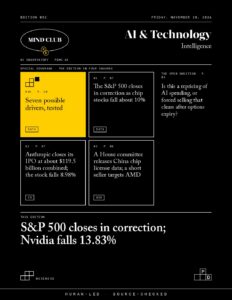
What happened. The S&P 500 fell 3.70% to 6,910.39 and the Nasdaq 100 fell 5.61% to 25,028.98, per Robinhood’s index feed; Investing.com put the S&P 500’s fall at 3.50%. Claim The S&P 500 is 11.62% below its 10.06 record close, by our arithmetic. Reuters and CNBC reported that the S&P 500 and the Dow closed in correction, and Reuters and CBS that the S&P 500’s seventh straight loss is its longest losing streak since February 2020. Claim The two big semiconductor ETFs fell 10.61% and 10.66%, and Nvidia, AMD, Micron and Arm each fell more than 13% in their last regular-session trades. Verified
Why it matters. The selling was deepest in the companies that sell into AI data centers, while the hyperscalers that buy from them fell less, 2.56% to 5.82%. That pattern fits a market questioning the pace of AI spending more than the buyers’ businesses. Analysis
What’s possible. Friday’s options expiry may have added to the move; the week of 11.23 should show whether the selling continues without it. Speculation
RED TEAM
A sharp fall can reflect positioning and forced selling more than news. The hyperscalers’ smaller falls may say as much about their size as about the market’s view of their spending.
Robinhood market data, 11.20 Data; Reuters, CNBC and CBS, 11.20 Press.
02
Must read
What happened. Anthropic announced the closing of its IPO: 1,127,000,000 Class A shares at $83.00, including the underwriters’ full option for 147,000,000 more, for gross proceeds of about $93.5 billion, about $91.6 billion of it to Anthropic. The concurrent private placement raised about $26.0 billion, for about $119.5 billion combined. Verified On its first full day of trading, ANT’s last regular-session trade was $88.445, down 8.98% from Thursday’s $97.17 close and 6.56% above the offer price. Verified It traded as low as $83.10 during the day, per TradingKey. Claim
Why it matters. The placement buyers are suppliers and partners: AMD, Broadcom, Google, Micron, Microsoft, Nvidia and TSMC Partners. Day two gave back about 60% of the first-day gain on a day the whole AI group fell. Analysis
RED TEAM
Two days of trading set no pattern. This brief is produced with Anthropic’s Claude models; Anthropic appears here as one of several companies, and Mind Club takes no position on its shares.
Anthropic, IPO closing release, 11.20 Co; Robinhood market data, 11.20 Data; TradingKey, 11.20 Press.
03
Must read
What happened. House Foreign Affairs Committee Chairman Brian Mast released Commerce license information showing requests to sell 3.4 million AI chips to China, of which more than 879,000 were approved, per the committee. Verified The release says Nvidia’s requests involved “possible chip-smuggling fronts.” Claim Separately, Hunterbrook Media published a report claiming that firmware from IEIT Systems, a unit of a company on the Commerce Entity List, contains versions of AMD’s startup firmware; Hunterbrook Capital disclosed a short position in AMD, and, per investingLive, the report says it cannot establish how IEIT obtained the code, whether a license existed or that any export violation occurred. Claim AMD said the claims “misrepresent AMD’s business practices and relationships” and that it “complies with applicable US export control laws and regulations and maintains rigorous processes to ensure compliance across our global operations,” per Forbes and investingLive. Claim
Why it matters. Both items raise the question of how much China exposure chipmakers carry under tighter rules, the week a Commerce rule on remote access took effect. Neither is a regulator’s finding. Analysis
RED TEAM
A short seller profits if the stock falls, and its own report limits what it can show. A committee release states the committee’s reading of the licenses, not a ruling.
House Foreign Affairs Committee release, 11.19 Gov; Forbes and investingLive on the Hunterbrook report, 11.19 to 11.20 Press.
04
Know it
What happened. Bloomberg reports that Apple is developing an agent that can use apps, browse the web, run commands and write code, that the work “remains in the early stages,” and that macOS 27.3 would warn users against giving third-party agents full computer access, per TechCrunch. Claim A day earlier, Google gave its Gemini Mac app the ability to operate native apps and files for paid U.S. subscribers, per TechCrunch. Claim Separately, Reuters reported that Meta’s Muse agent surfaced other employees’ messages in internal testing; Meta said employees use different versions of Muse than the public. Claim
Why it matters. The operating system owner may decide how much access outside agents get. Testing reports like Meta’s, if accurate, suggest why. Analysis
RED TEAM
Apple did not comment, and early projects change or stop. We did not open Bloomberg’s or Reuters’ reports.
TechCrunch on Bloomberg, 11.19 Press; TechCrunch on Gemini for Mac, 11.19 Press; TechCrunch on Reuters, 11.19 Press.
05
Know it
What happened. OpenAI estimates that the share of two-to-four-hour AI research tasks its agents complete without human help rose from 23% in March to 46% in October, and from 13% to 35% for four-to-eight-hour tasks. It calls the results “jagged”: 79% for monitoring training runs, 25% for inference and serving code. Claim
Why it matters. Longer tasks done without a person stepping in is one measure that matters for practical work, and OpenAI publishes where its agents still fail. Analysis
RED TEAM
These are OpenAI’s internal estimates on its own tasks. OpenAI says changes in what researchers choose to delegate may account for part of the gain, and its survey data are self-reported.
OpenAI, research acceleration report, 11.19 Co.
Know itVerifiedAnalysis
The price on the label starts with a cattle count.
USDA’s Economic Research Service forecasts retail beef and veal prices up 8.7% in 2026 (interval 7.4% to 10.1%), against 2.3% for all food at home. Verified
Underneath is the herd. On January 1, 2026, the U.S. had 86.2 million cattle and calves, slightly fewer than a year earlier. Beef cows fell 1% to 27.6 million, and the 2025 calf crop fell 2% to 32.9 million. Replacement heifers rose 1% to 4.71 million. Verified A heifer kept to breed is one not sold for beef, so a rebuild may tighten supply before it eases it. Analysis
Sources USDA ERS Food Price Outlook (10.23.2026) · USDA NASS Cattle (01.30.2026)
Know itVerified
Two datasets, one on paper and one by the clock.
Across the OECD, paid leave earmarked for fathers averages 13.4 weeks, from 0 in Israel, New Zealand and the United States to 82 in Korea. Paid leave available to mothers averages 54.9 weeks. Verified The table counts national entitlements as of April 2025, not who takes them; the OECD notes that 13 U.S. states and the District of Columbia had enacted mandatory paid family leave by February 2025. Verified
In the U.S. in 2025, adults living with a child under 6 spent 2.3 hours a day on primary childcare: women 2.8, men 1.7. Verified BLS halted interviews from October 1 to November 12, 2025, and says it can’t quantify the effect. Verified
Sources OECD Family Database PF2.1 (May 2026) · BLS American Time Use Survey (06.25.2026)
Know itVerified
Thickness and acidity vary too much for one safe process.
The National Center for Home Food Preservation says home canning isn’t recommended for pumpkin butter or any mashed or pureed pumpkin or winter squash. Verified Pumpkin is low-acid, above pH 4.6; a 1995 University of Missouri study found home-canned pumpkin butters as high as pH 5.4. University of Minnesota studies in the 1970s found thickness varied too much to calculate one process. Verified USDA’s guide covers cubes only: “Caution: Do not mash or puree.” Verified FoodSafety.gov lists improperly home-canned low-acid vegetables among the sources of botulism. Verified
The safe route, per UC Master Food Preservers: keep pumpkin butter in the refrigerator or freezer and treat it like fresh pumpkin. Verified
Sources National Center for Home Food Preservation (12.07.2012) · FoodSafety.gov (reviewed 08.14.2025) · UC Master Food Preservers (checked 10.30.2026). General information, not medical advice.
ScanVerifiedClaimTaste
A wet-hulled lot scored 90.1 at Cup of Excellence Indonesia.
At Cup of Excellence Indonesia 2026, the No. 2 lot scored 90.1: 100% Ateng, wet hulled, from Aceh Tengah, Sumatra. The No. 1 lot, at 90.25, was an experimental washed and honey lot from Bandung Barat, half of it Ateng. Verified
Wet hulling strips the parchment while the coffee is still wet, typically at 35% to 50% moisture against about 10% to 12% for most coffees. The importer Cafe Imports says it suits Sumatra’s damp climate and helps smallholders sell sooner. Claim
Taste:
a process built around weather and cash flow, 0.15 points off first, is the story. Prices wait for the auction, December 1 at 13:00 UTC. Verified
Sources Alliance for Coffee Excellence (checked 10.30.2026) · Cafe Imports (checked 10.30.2026)
BRIGHT SPOT
VerifiedClaimTaste
Mali Obomsawin’s Automatic turns archival tape into new music.
Mali Obomsawin’s Automatic came out on October 16 on Out Of Your Head Records. Verified The bassist and composer, a citizen of the Odanak First Nation of the Abenaki, works sampled archival voices into free improvisation and rock, with Andrew Broder on turntables. Verified (credits) Claim (sound and citizenship, per Bandcamp Daily) Bandcamp Daily reports that Dartmouth began returning ethnological tapes to Odanak. Claim “I think being able to let these recordings unleash themselves is giving agency to the people who are in them,” she told the site. Claim
Start here: track 2, “Automatic” (4:45). Taste: tape that left a community, coming home as new music.
Sources Mali Obomsawin on Bandcamp (10.16.2026) · Bandcamp Daily, Bret Sjerven (10.15.2026)